How to Write Meeting Minutes for a Multilingual Team (Template + Bilingual Summary Workflow)
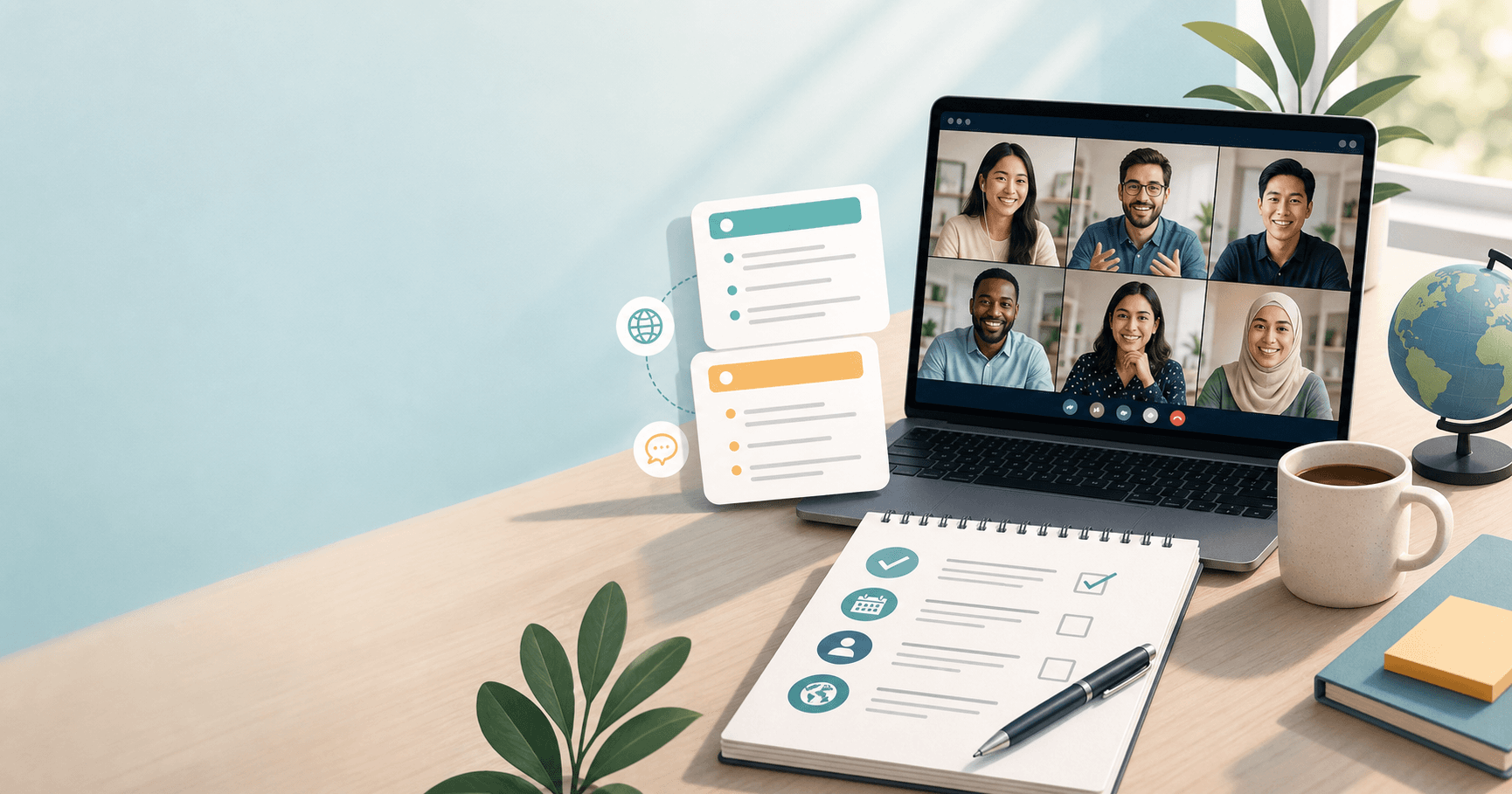
When a meeting spans languages, “meeting minutes” often fail for one simple reason: the notes are written in one language and assume one cultural context. Half the team leaves unclear on decisions, owners, and what to do next—especially if they joined via live interpretation, captions, or a second-language speaker mode.
This guide gives you a fast workflow and a copy/paste template that works for multilingual teams. The goal is not perfect translation—it’s shared clarity.
The fast answer (what to do right after the meeting)
- Write the minutes in a decision-first format (Decisions → Action items → Risks → Context).
- Create a “simple language” version (short sentences, no idioms, one idea per bullet).
- Add a bilingual summary (or “primary + secondary language” summary) for the top 10% that matters: decisions + action items.
- Confirm names, dates, and numbers (these are where cross-language errors hurt most).
- Send the minutes with explicit confirmation prompts (“Reply YES if correct / corrections by Friday 5pm”).
If you only do one thing: make action items unambiguous (owner + verb + due date + definition of done).
Why multilingual minutes break (and how to fix it)
Common failure patterns:
- Idioms and “soft” language (“we should probably…”, “let’s circle back”) read as optional.
- Ownership is implied instead of explicit (“someone will follow up”).
- Different decision styles (some cultures treat tentative discussion as agreement; others require explicit confirmation).
- Translation drift (a “maybe” becomes a “yes,” or vice versa).
Fix: treat your minutes like an interface. Optimize for:
- Precision (what was decided)
- Attribution (who owns what)
- Timing (when it happens)
- Verification (how we know we’re aligned)
A practical workflow that takes 12 minutes
0–2 minutes: Capture the meeting header
- Meeting title
- Date/time + timezone
- Attendees (including interpreters)
- Language modes used (e.g., “English spoken, Mandarin interpreted”)
2–6 minutes: Decisions and action items first
Write these before you write context. You’ll be surprised how much “context” becomes unnecessary once the team sees the decisions.
6–10 minutes: Simple-language recap
Rewrite any long or nuanced paragraph into:
- short sentences
- concrete nouns
- no idioms
- one bullet = one idea
Example:
Instead of: “Let’s touch base next week and see if we can move the needle.”
Write: “We will meet next week to review progress and decide next steps.”
10–12 minutes: Bilingual summary (only the critical parts)
You don’t need to translate the whole doc. Translate:
- Decisions
- Action items
- Deadlines
- Numbers/prices/quantities
If you don’t have a human translator, have a bilingual teammate verify the top section only.
Meeting minutes template (copy/paste)
Use this structure even if you keep it short.
1) Meeting info
- Meeting:
- Date/time (timezone):
- Attendees:
- Languages / interpretation:
- Recording/transcript: (yes/no + link)
2) Decisions (final)
- D1:
- D2:
3) Action items (owner + due date + definition of done)
- A1 (Owner, Due): Verb + outcome. Done when:
- A2 (Owner, Due): Verb + outcome. Done when:
4) Open questions / risks
- Q1: What we need to answer + who will answer + by when
- Risk: What could go wrong + mitigation + owner
5) Context (only what future readers need)
- Key points (simple language)
6) Confirmation request
Please reply by (date/time) with corrections. If everything is correct, reply “Confirmed.”
Bilingual summary template (top-of-doc)
Place this at the top so everyone sees it first.
Summary (Language A)
- Decisions:
- Action items:
Summary (Language B)
- Decisions:
- Action items:
Tip: if you’re not fully confident in the translation, add one line:
“If any wording feels unclear, please ask—we’ll clarify quickly.”
What to be extra careful about (international teams)
- Dates and timezones: always write the timezone and also include a UTC time if teams are global.
- Money: currency + whether taxes/shipping are included.
- Names and roles: correct spelling, titles, and decision-makers.
- Legal/compliance wording: don’t “approximate” in translation—escalate for review.
How Leyo helps (cross-language clarity + shared meeting memory)
Most tools stop at “captions” or “translation.” The real problem is: teams forget—especially when the meeting wasn’t in their strongest language.
Leyo is building AI-powered communication across languages and cultures, including:
- Leyo Meet for simpler multilingual meetings
- Cross-language chat so follow-ups stay readable for everyone
- Shared meeting memory (decisions, owners, context that survives the call)
- Follow-up support that turns minutes into action (and helps you remember what to do next)
If your meetings are international—clients, suppliers, family across borders—Leyo’s goal is to make your communication feel natural and operationally reliable.
If you tell me your two languages (e.g., English ↔ Spanish) and the meeting type (sales, ops, family planning, travel), I can adapt the bilingual summary section and the confirmation prompts to match your context.